Category Archives: Planning & Advocacy

Two Bridges weighs in on critical issues concerning not only quality of life, but the future of our neighborhood. Whether through our own initiatives or in partnership with others, we work to engage residents and other local stakeholders in participatory planning processes to ensure that everyone understands the issues at hand, and everyone’s voice is heard.

Cooper Lumen Design Challenge

Creating a Working Prototype for a Solar-Powered Public WiFi Hotspot & Charging Station

The Cooper Lumen Design Challenge is an innovative, cross-disciplinary design challenge for students at Cooper Union, aimed at creating a working prototype for a solar-powered public WiFi hotspot.

Unlike other solar powered products, the “Cooper Lumen”  will uniquely combine the functions of providing public wireless internet, emergency lighting, and a charging station for computers and mobile devices.

The semester-long design initiative commenced in January 2014, and will include students from the Cooper Union schools of Art, Architecture, and Engineering.

Engaging Innovative Student Design to Enhance Community Resiliency in Post-Sandy NYC

The resulting design(s) will become candidates for deployment in the WiFi-NY People’s Emergency Network, which will place these units along Manhattan’s East River Waterfront and in common areas in and around the Two Bridges, Lower East Side, Chinatown, East Village and other New York City neighborhoods.

These neighborhoods — much of which are made up of high-rise affordable housing developments — were particularly impacted by Superstorm Sandy’s storm surge, leaving thousands of vulnerable families and elders trapped without power, communications, transportation, or supplies.  For many buildings, it took weeks to restore power and communications.

The overall goal of the Cooper Lumen Design Challenge is to help residential corridors impacted by Superstorm Sandy come back even stronger by encouraging the development and implementation of durable and reliable devices that will anchor these neighborhoods for years to come.

Support the Cooper Lumen Design Challenge

We hope that you will join us in supporting this momentous endeavor. Please check out the various ways you can support and give at any level you can.

All proceeds raised will go towards covering the costs of materials and physical hardware the students will need in order to conduct their work, including solar cells, batteries, charge controllers, LED lights, wireless equipment, and structural elements.

Please note: all support is tax-deductible. Two Bridges Neighborhood Council, a longstanding community organization, is serving as the 501(c)(3) fiscal sponsor of this project.

Thank you in advance for your support!

Project Team 

The project team acknowledges the ongoing work and support of LES Ready!, (formerly known as the Lower East Side Long Term Recovery Group), a coalition of over 70 community groups and institutions that are working to cooperatively coordinate response, resources, preparedness planning and training in response to Hurricane Sandy and in the event of future disasters. 

Two Bridges Rain Garden

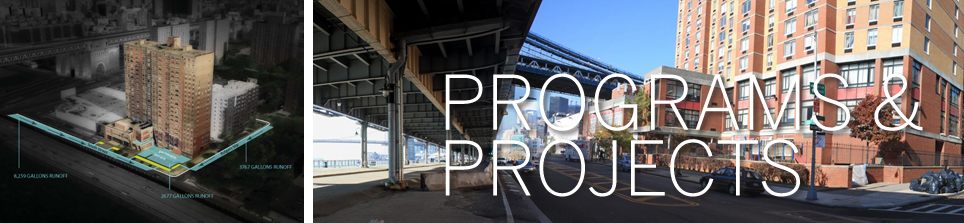
Two Bridges Neighborhood Council has been awarded a Green Infrastructure Grant from the New York City Department of Environmental Protection (NYCDEP) for the construction of a rain garden at Two Bridges Tower.

The Rain Garden will provide:

  • New and improved seating/social areas
  • Shade and localized cooling benefits
  • Mitigation of particulate matter and hydrocarbon pollution generated by the FDR and South Street Truck Route
  • Training and educational opportunities for residents interested in gardening
  • A play area for children in the building as well as the Hamilton-Madison House Day Care & Headstart programs

The garden will be designed by dlandstudio, pllc, a multidisciplinary design firm based in Brooklyn. Check out ourAugust 2012 articlediscussing the opportunities for deploying green infrastructure throughout our neighborhood, including the rain garden at 82 Rutgers Slip. We thank our local elected officials for their ongoing support of this project: Congresswoman Nydia Velazquez, State Senator Daniel Squadron, and Councilmember Margaret Chin.


Frequently Asked Questions

Will there be standing water? No, the rain garden is designed to absorb water so that it does not run off into storm drains.

Will the rain garden prevent us from using the “back yard”? No, the rain garden is intended to provide a healthier, more pleasant and enjoyable social space, and to encourage its use.

I heard there will be sewage treatment back there. Is that true? No. Only clean rainwater is infiltrated into the rain garden—that’s why it is called a rain garden. The confusion may have arisen from the fact that we are keeping clean rainwater out of the storm sewer, and helping cut down on storm sewer overflows in rain events, which can cause sewage to be sent untreated from the sewer to the river. Only water that falls on the roof and surface of the 82 Rutgers Slip property will be absorbed in the rain garden.

I heard you are taking away our playground. Is that true? No. The current play equipment is out of date and in need of replacement. While the rain garden grant does not cover the cost of new equipment, Two Bridges is committed to working with residents and Hamilton-Madison House to design and implement an age-appropriate play area within the garden that will include both educational and physical recreational components.

What about furniture deliveries? All deliveries can still take place through the garden area. There will be a sidewalk, just like in the current design.

How Does A Rain Garden Work? Rain gardens cut down on the amount of stormwater being sent into storm drains by using plants to infiltrate rainwater. At 82 Rutgers, rainwater will be diverted from the building roof to a new lawn, trees and planting beds. Plants have a lot of surface area to capture raindrops and allow the water to slowly infiltrate into the soil below. A deep bed of gravel below the soil further slows the water so it has time to infiltrate completely.

What Else Does a Rain Garden Do? In addition to being functional, rain gardens can be beautiful. They also provide localized cooling benefits, shade, and improved air quality. On a south-facing exposure like 82 Rutgers Slip, summer sun can make it unbearably hot, and hard surfaces like concrete and paving trap and radiate this heat. A rain garden can help create a cooler microclimate in this area, making it more pleasant to sit, socialize or play.

Rain garden directly remove pollutants from the air. As an essential social space for residents, air quality is important. The residue of heavy vehicular exhaust– particulate matter–generated by the South Street Truck Route and the elevated FDR Drive can be seen on windowsills, and unseen chemicals in vehicular exhaust are suspended in the air in urban areas. Particulate matter and hydrocarbons from burning fossil fuels are extremely harmful if breathed in. Plants can trap particulates on their leaves; some can even break down environmental pollutants, like hydrocarbons, keeping them out of our soil, water and bodies.

Gardens have a proven positive impact on our mood and health. The rain garden at 82 will create opportunities for residents interested in gardening, and provide a living science laboratory for children participating in Two Bridges’ after-school and summer camp programs.

How Do Rain Gardens Help Protect Water Quality? New York City relies on an outdated sewer design called a “Combined Sewer Overflow” or CSO. During storm events, rainwater falling on hard surfaces like buildings, sidewalks and streets, runs off in to storm drains, bringing with it oils, trash, and other pollutants from the streets. The stormwater is combined with raw sewage and piped to sewage treatment plants. When overwhelmed by excessive stormwater runoff, CSOs divert the combination of polluted stormwater and raw sewage away from treatment plants, allowing it to flow directly into the surface waters around New York.

There are sixteen (16) CSO outfalls between the Brooklyn Bridge and Montgomery Street in the Two Bridges neighborhood, meaning that there are 16 pipes sending raw sewage and polluted stormwater into the East River every time there is a heavy rainfall. This is not only bad for the health of the river and animals that depend on it, but for the health of people living along it. In addition to smelling bad, raw sewage has the potential to spread infectious disease to those coming into contact with it.

Background

Two Bridges provides leadership and advocacy to protect the interests of and to engage residents in the improvement of South Street and the East River Waterfront. We are pleased to partner with residents, other community-based organizations, and city agencies to address these concerns, for which we have advocated for over 30 years.

Since Hurricane Irene in August 2011 demonstrated the potential for contaminated water to flood the Two Bridges neighborhood, Two Bridges has been looking for ways to limit stormwater runoff, which pollutes our waterways, and to provide environmental benefits to the residents of our buildings in the low-lying East River Waterfront.

The vulnerability of our tenants and buildings, as evidenced by the experience of Superstorm Sandy and the realities of climate change, compels Two Bridges and Settlement Housing Fund, the sponsors of Two Bridges Tower, to address environmental issues in new, innovative ways.
Long-Term Sustainability of Our Waterfront Community

In the darkness of Monday evening, October 29th, Hurricane Sandy’s nearly 14′ high storm surge flowed up and over and into the homes and businesses of coastal New York City, wreaking havoc on its most essential infrastructure: Power, Transportation, Communication. The human impacts were even greater–lives lost, homes destroyed, and many people isolated and cut off from food, water, medicine. The Lower East Side was among the hardest hit neighborhoods of Manhattan, especially along the shore, where large campuses of high-rise public and subsidized housing stand on low-elevation fill, barely above sea level.

This storm event gives us all pause, especially in thinking about the long-term sustainability of our waterfront community and the deeper level of planning and design necessary to keep residents in place and safe in this neighborhood.The short term recovery in Manhattan’s Lower East Side is going to be hard, but the longer term planning and approaches to urban design of the neighborhood will be much more complicated. Two Bridges Neighborhood Council has been thinking deeply about this ever since last year’s Tropical Storm Irene flooding, when we first recognized the vulnerability of the neighborhood to sea level rise and storm events.

When the emergencies have subsided, we will continue to push to engage the city in dealing meaningfully with issues of stormwater & storm surge in the neighborhood. In the meanwhile, here is a link to an article written this summer about the issue, complete with a sadly accurate storm surge map:

Click here for more information.

Advocacy & Planning

Two Bridges weighs in on critical issues concerning not only quality of life, but the future of our neighborhood. Whether through our own initiatives or in partnership with others, we work to engage residents and other local stakeholders in participatory planning processes to ensure that everyone understands the issues at hand, and everyone’s voice is heard.

South Street Stakeholders

South Street Stakeholders

In March 2012, Two Bridges hosted the first in a series of South Street Stakeholder meetings to discuss opportunities to implement better streetscape & urban design, including green infrastructure, to connect the Two Bridges Neighborhood between the Brooklyn Bridge and Montgomery Street to the East River Waterfront Esplanade. The stakeholders group includes property owners, residents, city agencies, elected officials, community board members and other interested parties.

For too long, this stretch of South Street has been a neglected corridor of dumpster platforms and parking lots, where most buildings fail to address the street and/or the water. With the new park developments along South Street, including the forthcoming Pier 42 at Montgomery Street, this area must better connect to the waterfront, for the benefit of owners and residents alike. 

At this critical time, we see opportunities to:

  • Develop new or redesign existing street crossings to enable pedestrians and cyclists to safely reach the waterfront while calming traffic on this busy truck route; 
  • Create more lively and active street life, thus safer streets, by encouraging commercial and residential infill to address South Street;
  • Reduce stormwater runoff and improve the health of the East River by incorporating green infrastructure into streetscapes and private property.
  • Manage storm surges in this low-lying coastal area through green technologies that can function in fair weather as parks and public space. 
  • Address storm surge potential though appropriate architectural design.
 

Seward Park Urban Renewal Area (SPURA)

Seward Park Urban Renewal Area (SPURA)

SPURA, under the auspices of the New York City’s Economic Development Corporation and Office of Housing Preservation & Development, with guidance by Community Board 3, must fulfill a powerful, creative, socially, economically, and environmentally sustainable vision in order to meet the needs of our community. On the books since 1965 and to-date undeveloped, SPURA  is potentially the last significant large-scale development project on the Lower East Side for many years to come. 

In 2008, Two Bridges participated in Community Voices and the Future of the Seward Park Urban Renewal Area, a joint project spearheaded by GOLES and the Pratt Center for Community Development, in partnership with a broad coalition of community-based organizations, to envision the scale and scope of the urban renewal area.

The political, social, and economic complexities surrounding the development of these sites has prevented the realization of this essential project for almost fifty years. In the context of the Lower East Side neighborhood, and to meet the needs of the business community and residents, Two Bridges advocates for:

  • The creation of a maximum amount of affordable housing (more than the 50%); The number of affordable housing units must be maximized, and all affordable housing units created must remain permanently affordable.
  • The inclusion of a public school and other community facilities in the non-residential square-footage; large ground and second floor non-residential space should be reserved for a public school, urgent or preventative care services, a grocery store, an affordable fitness center and/or a movie theatre & cultural or performing arts space.
  • A limitation of square footage on commercial space; in keeping with the scale of the neighborhood and character of small, local businesses, no retail commercial unit should be larger than 10,000 square feet.
  • Job creation in this neighborhood with a disproportionately high unemployment rate; local hiring must be stipulated in all scoping documents, and all efforts must be made to ensure that companies follow through in hiring local workers; and a portion of commercial square footage should be dedicated as a business incubator and affordable office space for small businesses and non-profits.

SPURA development must seamlessly integrate with the existing neighborhood from both a design and demographic perspective. The resultant residential, commercial, and community spaces must enhance the quality of life for all, and pay particular respect to the residents and businesses that for decades have bound together as a community in a neighborhood that many others—including the city—had overlooked.


Lower East Side Waterfront Alliance

Lower East Side Waterfront Alliance

For almost 60 years Two Bridges Neighborhood Council has had at the heart of its mission the goal of improving the quality of life for the residents of the Lower East Side. For more than a decade, our advocacy efforts have turned toward the waterfront, working with the city to explore ways to provide recreational access to the waterfront for the first time in history.

The Lower East Side Waterfront Alliance, a growing alliance of neighborhood organizations, concerned residents, property owners, tenant associations, professional social, health and educational institutions, and others, is committed to the economic, environmental, and social sustainability of the East River Waterfront along the Two Bridges neighborhood, Corlear’s Hook and East River Park to serve the adjacent Lower East Side & Chinatown communities.

Our goal is to work together to become active stewards of the ongoing redevelopment of the waterfront and its future use. The Lower East Side Waterfront Alliance members are working on many projects to bring attention to the East River Waterfront, including the Esplanade & Greenway, and Pier 42 and its possibilities. These include Paths to Pier 42 , a project to activate the waterfront through temporary art installations and events.

Lower East Side Waterfront Alliance Members:

Two Bridges Neighborhood Council

Hester Street Collaborative

GOLES

Lower East Side Ecology Center

Cherry Street Tenants Association

Land’s End Tenants Association

CAAAV


Local Spokes

Local Spokes

Formed in2010 as the Lower East Side-Chinatown Bicycling Coalition, Local Spokes’ nine partner organizations work together to engage local residents to envision the future of bicycling in the diverse neighborhoods of Manhattan’s Lower East Side. We seek to understand the community’s various perspectives through multilingual outreach, community visioning sessions, and a youth ambassadors program. This participatory process will result in the drafting of a conceptual plan and development of additional resources to address potential barriers and increase accessibility to bicycling. Ultimately we hope to create a new model for inclusive and sustainable transportation planning & development.

Local Spokes members include nine partner organizations:

Asian Americans for Equality

Good Old Lower East Side (GOLES)

Green Map System

Hester Street Collaborative

Recycle-A-Bicycle

Times Up!

Transportation Alternatives

Two Bridges Neighborhood Council

Velo City

Chinatown Working Group

Chinatown Working Group

Since 2009, Two Bridges has actively participated in the Chinatown Working Group (CWG), a community-based planning initiative to help shape the future of Manhattan’s Chinatown, and to formulate and work with New York City agencies to implement a precise, comprehensive, meaningful, timely and broadly supported community-based plan. The CWG stakeholders coalition consists of civic, cultural, community and small business organizations, individuals, representatives of Community Boards 1, 2 & 3, and other interested parties. Two Bridges has a particular interest in issues of housing affordability, preservation, neighborhood revitalization, and the social and economic well being of families, seniors and youths.